Overview

Start Simple

i
def find_duplicates(filenames):
    matches = []
    for left in filenames:
        for right in filenames:
            if same_bytes(left, right):
                matches.append((left, right))
    return matches


if __name__ == "__main__":
    duplicates = find_duplicates(sys.argv[1:])
    for (left, right) in duplicates:
        print(left, right)

Byte by Byte

i
def same_bytes(left_name, right_name):
    left_bytes = open(left_name, "rb").read()
    right_bytes = open(right_name, "rb").read()
    return left_bytes == right_bytes

Test Case

a1.txt a2.txt a3.txt b1.txt b2.txt c1.txt
aaa aaa aaa bb bb c

Test Output

i
python brute_force_1.py tests/*.txt
i
tests/a1.txt tests/a1.txt
tests/a1.txt tests/a2.txt
tests/a1.txt tests/a3.txt
tests/a2.txt tests/a1.txt
tests/a2.txt tests/a2.txt
tests/a2.txt tests/a3.txt
tests/a3.txt tests/a1.txt
tests/a3.txt tests/a2.txt
tests/a3.txt tests/a3.txt
tests/b1.txt tests/b1.txt
tests/b1.txt tests/b2.txt
tests/b2.txt tests/b1.txt
tests/b2.txt tests/b2.txt
tests/c1.txt tests/c1.txt

Revise Our Approach

i
def find_duplicates(filenames):
    matches = []
    for i_left in range(len(filenames)):
        left = filenames[i_left]
        for i_right in range(i_left):
            right = filenames[i_right]
            if same_bytes(left, right):
                matches.append((left, right))
    return matches
Looping over distinct combinations
Figure 1: Scoping the inner loop to produce unique combinations.

Algorithmic Complexity

Grouping Files

Grouping by hash code
Figure 2: Grouping by hash code reduces comparisons from 15 to 4.

Naive Hashing

i
def naive_hash(data):
    return sum(data) % 13
i
    example = bytes("hashing", "utf-8")
    for i in range(1, len(example) + 1):
        substring = example[:i]
        hash = naive_hash(substring)
        print(f"{hash:2} {substring}")
i
 0 b'h'
 6 b'ha'
 4 b'has'
 4 b'hash'
 5 b'hashi'
11 b'hashin'
10 b'hashing'

How Good Is This?

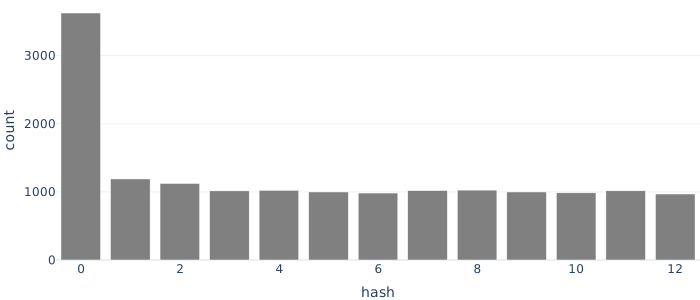
Hash codes of *Dracula*
Figure 3: Distribution of hash codes per line in *Dracula*.

After a Little Digging…

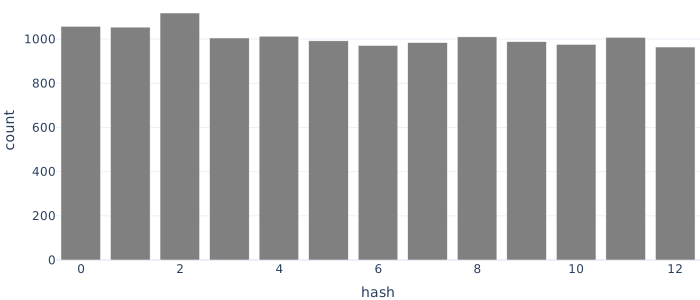
Hash codes of unique lines of *Dracula*
Figure 4: Distribution of hash codes per unique line in *Dracula*.

Modifying Our Program

i
def find_groups(filenames):
    groups = {}
    for fn in filenames:
        data = open(fn, "rb").read()
        hash_code = naive_hash(data)
        if hash_code not in groups:
            groups[hash_code] = set()
        groups[hash_code].add(fn)
    return groups

Modifying Our Program

i
    groups = find_groups(sys.argv[1:])
    for filenames in groups.values():
        duplicates = find_duplicates(list(filenames))
        for (left, right) in duplicates:
            print(left, right)
i
tests/a2.txt tests/a1.txt
tests/a3.txt tests/a1.txt
tests/a3.txt tests/a2.txt
tests/b1.txt tests/b2.txt

But We Can Do Better

We Don't Need Groups

SHA-256 Example

i
    example = bytes("hash", "utf-8")
    for i in range(1, len(example) + 1):
        substring = example[:i]
        hash = sha256(substring).hexdigest()
        print(f"{substring}\n{hash}")
i
b'h'
aaa9402664f1a41f40ebbc52c9993eb66aeb366602958fdfaa283b71e64db123
b'ha'
8693873cd8f8a2d9c7c596477180f851e525f4eaf55a4f637b445cb442a5e340
b'has'
9150c74c5f92d51a92857f4b9678105ba5a676d308339a353b20bd38cd669ce7
b'hash'
d04b98f48e8f8bcc15c6ae5ac050801cd6dcfd428fb5f9e65c4e16e7807340fa

Duplicate Finder

i
import sys
from hashlib import sha256

def find_groups(filenames):
    groups = {}
    for fn in filenames:
        data = open(fn, "rb").read()
        hash_code = sha256(data).hexdigest()
        if hash_code not in groups:
            groups[hash_code] = set()
        groups[hash_code].add(fn)
    return groups


if __name__ == "__main__":
    groups = find_groups(sys.argv[1:])
    for filenames in groups.values():
        print(", ".join(sorted(filenames)))

Duplicate Finder

i
python dup.py tests/*.txt
i
tests/a1.txt, tests/a2.txt, tests/a3.txt
tests/b1.txt, tests/b2.txt
tests/c1.txt

Learning Debt

Summary

Concept map for finding duplicate files
Figure 5: Concept map.