Data Visualization
Compare candidate approval ratings
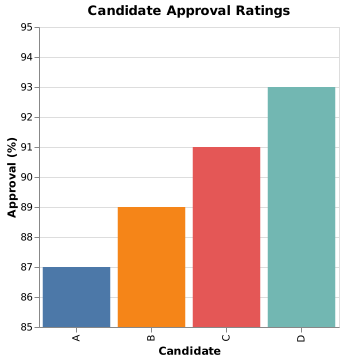
Compare the visual height of candidate A's bar to candidate D's bar. How much larger does D appear? Now look at the actual numbers. How large is the real difference?
Show explanation
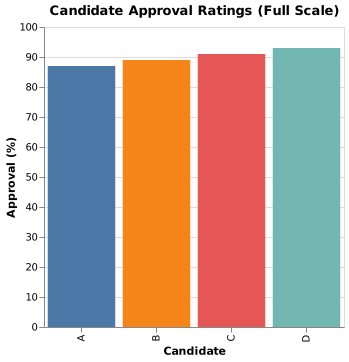
The Y-axis starts at 85 instead of 0. Candidate D's approval (93%) is only 6 percentage points above candidate A's (87%), but the bars make it look roughly three times taller. Any bar chart where the Y-axis does not start at zero exaggerates relative differences. The effect is proportional to how far the baseline is raised: the higher the floor, the more dramatic the distortion.
Shows: how a non-zero baseline inflates visual differences in bar charts out of proportion to the underlying data.
To find it: check where the Y-axis starts. If it starts above zero on a bar chart, divide the visual height ratio of two bars by their actual data ratio. If the visual ratio is several times larger than the data ratio, the truncated axis is distorting the comparison.
Assess a product's long-term performance trend
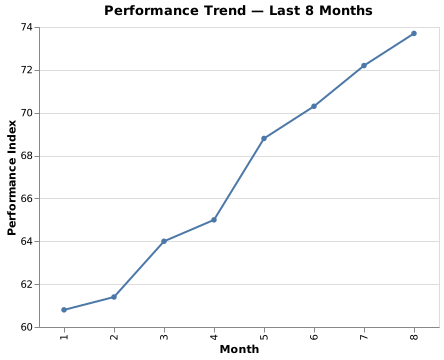
The chart shows a clear upward trend over 8 months. What conclusion might you draw about this product's long-term trajectory? What information would you need to know whether this is reliable?
Show explanation
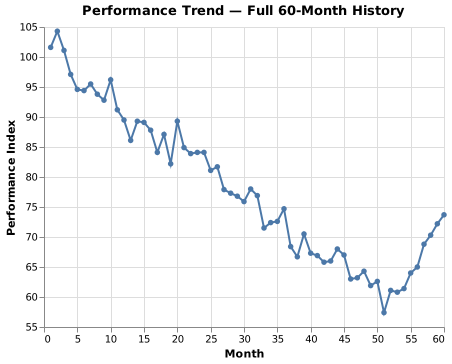
The 8 months shown are a recovery from a multi-year decline. The full 5-year series falls from 100 to roughly 52 before the recent uptick. Choosing a start date at the bottom of a trough guarantees an upward slope. This pattern is common in financial and performance reporting: selecting the window that flatters the story while omitting the longer context that contradicts it.
Shows: how selecting a window that starts at a historical low manufactures an upward trend that disappears when the full series is shown.
To find it: ask what the full dataset covers and compare the chart's start date to the earliest available data. If the start date coincides with a local minimum, extend the chart to show the complete history. If only the selected window is available, that absence of context is itself a warning sign.
Interpret the relationship between coffee consumption and code commits
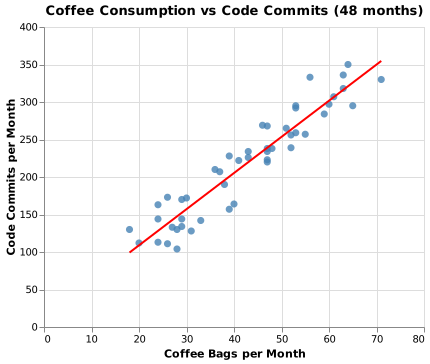
The scatter plot shows a strong positive relationship between monthly coffee consumption and code commits, with a tight regression line. What conclusion might a reader draw? What third factor might explain the pattern?
Show explanation
Both metrics grow because the engineering team grew: more engineers means more commits and more coffee consumed. Plotting two time-trending variables against each other removes the time axis entirely and makes a shared common cause look like a direct relationship between the two variables. Any two series that both trend in the same direction will produce a scatter that looks correlated, regardless of whether they have anything to do with each other.
Shows: how two variables driven by the same common cause (team size) appear strongly correlated in a scatter plot even when there is no direct relationship between them.
To find it: color the scatter plot points by time, with early months dark and late months light. If early months cluster in one corner and late months in the opposite, the apparent correlation is temporal ordering rather than a direct relationship. Then ask whether a plausible common cause — such as growth in team size — could explain both trends independently.
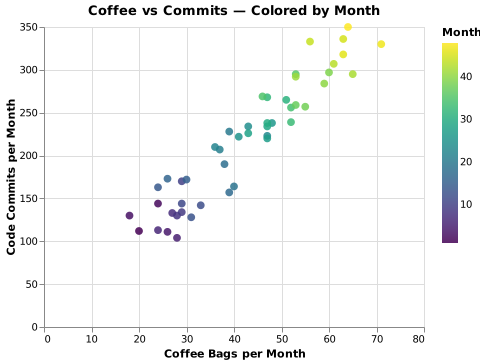
Early months cluster in the lower left and late months in the upper right — the apparent correlation is entirely temporal ordering.
Interpret the relationship between study hours and exam scores
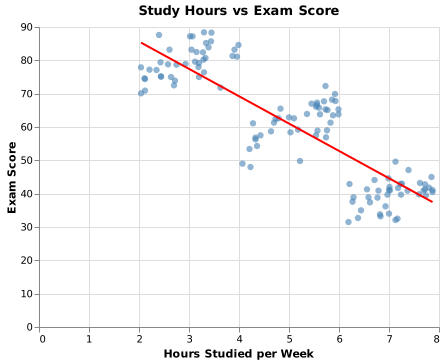
The trend line shows that students who study more tend to score lower. Does that mean studying is counterproductive? What might explain the pattern?
Show explanation
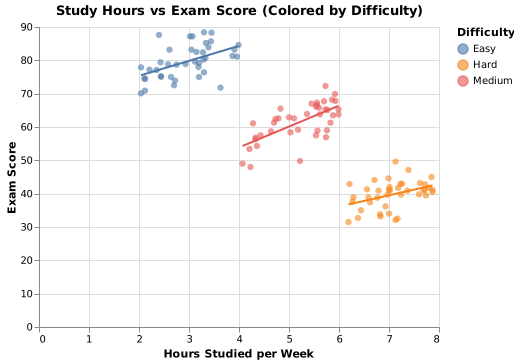
Students in harder courses study more hours but earn lower scores because the courses are harder, not because studying hurts performance. Within each difficulty level the relationship is positive: more study leads to higher scores. The aggregate trend reverses because a third variable — course difficulty — drives both the study hours and the scores. Adding a color encoding for difficulty would reveal three upward slopes instead of one downward one. This is Simpson's Paradox: an aggregate trend that disappears or reverses when a confounding variable is introduced.
Shows: how a confounding variable can reverse the direction of an aggregate trend, making a genuinely positive relationship appear negative in the pooled data.
To find it: color or facet the scatter plot by a categorical variable you suspect might be driving the outcome—here, course difficulty. If the aggregate slope reverses within each group, the confound is real. List candidate confounds before looking at the data: any variable that plausibly affects both axes is worth testing.
Compare two groups by average score
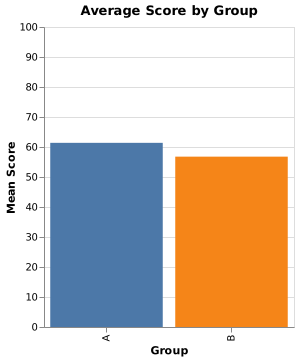
Both groups have nearly the same average score. Would you conclude they are performing similarly? What other chart type would you choose before drawing that conclusion?
Show explanation
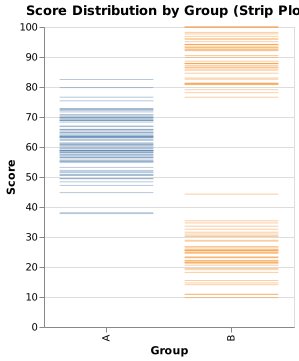
Group A is roughly normally distributed around 62. Group B is bimodal: half the students score near 25 and half score near 90. Both groups have the same mean, but their situations are completely different — Group B has two distinct subpopulations that the mean obscures entirely. A strip plot, histogram, or violin chart would make the bimodal structure immediately visible. Reporting only the mean discards the information most relevant to understanding Group B.
Shows: how identical means can hide completely different distributions, including bimodal structure that would demand a different response from an educator or manager.
To find it: replace the bar chart of means with a strip plot, histogram, or violin chart of the raw values. If the two groups look different in the distribution chart despite identical averages, or if one group shows two distinct clusters, the mean was suppressing the most important information in the data.
Identify which city has the worst traffic safety record
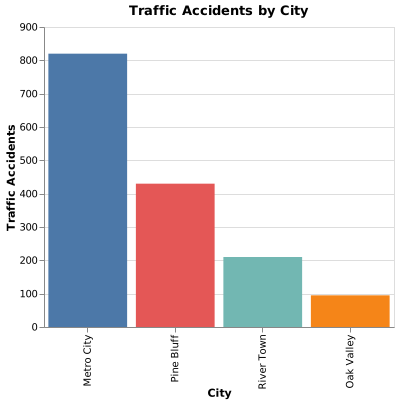
Which city appears to have the most serious traffic safety problem? Now calculate accidents per 100,000 residents for each city using the figures below. Does the ranking change?
Metro City: 820 accidents, population 2,100,000. River Town: 210 accidents, population 180,000. Oak Valley: 95 accidents, population 52,000. Pine Bluff: 430 accidents, population 640,000.
Show explanation
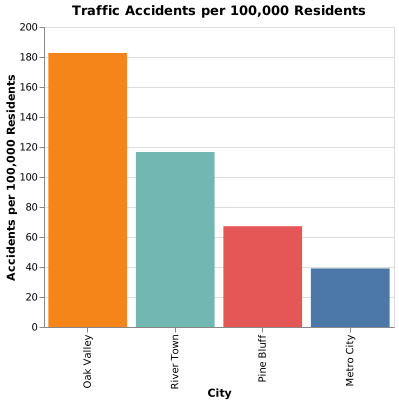
Metro City's raw count is largest, but its rate is 39 per 100,000 — the lowest of the four. Oak Valley has only 95 accidents but a rate of 183 per 100,000 — nearly five times higher. Absolute counts favor larger populations and are only meaningful when comparing groups of similar size. Any comparison that involves groups of different sizes requires a denominator: rate, proportion, or per-capita figure.
Shows: why absolute counts mislead whenever the groups being compared differ in size, and how normalizing to a rate can reverse the apparent ranking entirely.
To find it: divide each group's count by its population (or another appropriate denominator) and compare the normalized rates. If the rankings change after normalizing, the raw counts were misleading. As a rule of thumb, if the groups differ in size by more than a factor of two, rates are almost always more informative than counts.
Assess a product's user growth over the past year
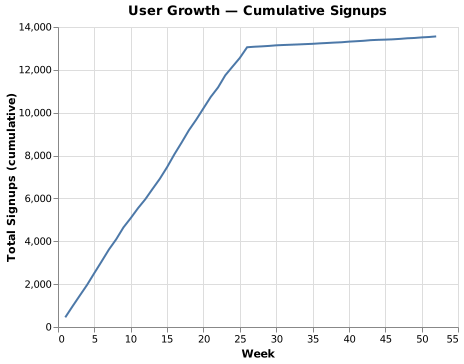
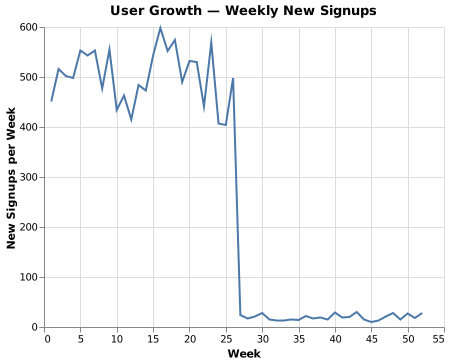
The total user count is rising steadily. Would you describe the product as growing? Now think about what the weekly rate of new signups looks like in the second half of the year compared to the first.
Show explanation
A cumulative chart can only go up or stay flat: it can never show a decline even if new additions stop entirely. Weeks 1-26 add 400-600 users each; weeks 27-52 add 10-30. The product's growth has effectively stopped, but the cumulative line looks like a healthy upward trend throughout. Plotting the weekly rate instead reveals the collapse in new signups. Cumulative charts are useful for showing totals but systematically hide any information about acceleration, deceleration, or stagnation.
Shows: how a cumulative chart makes stagnating growth look like a continuous upward trend by construction, since it can never decrease.
To find it: compute the period-over-period difference (subtract each value from the previous one to get weekly new additions) and plot that instead of the running total. If the differences drop sharply while the cumulative line keeps rising, growth has stopped even though the total continues to climb.
Read exam scores by hours studied for 600 students
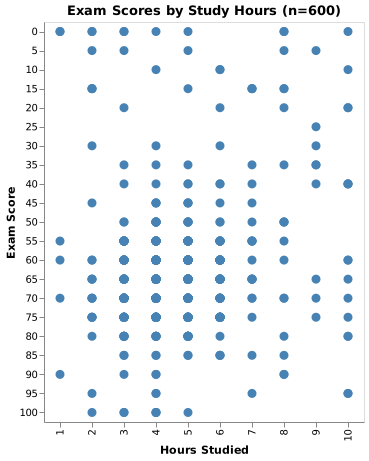
How many students appear to have studied for 4 hours and scored 65? How confident are you that each visible dot represents the same number of students?
Show explanation
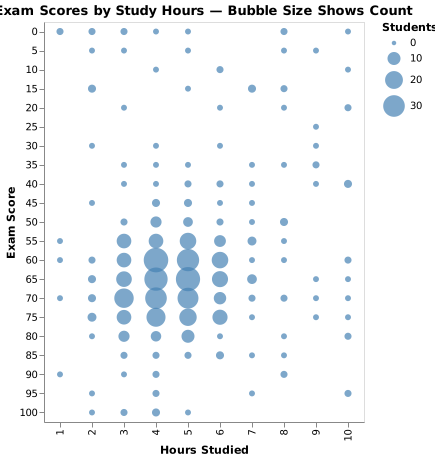
Both the exam scores (multiples of 5) and hours studied (integers) are discrete, so many students share the same coordinates. Opaque markers stack on top of each other and become indistinguishable from a single point: a position with 40 students on top of each other looks identical to a position with 1. The chart gives no indication of how populated each cell is, making the data appear uniformly distributed when 80% of students cluster at 3-6 hours and scores of 55-75.
Shows: how opaque markers on discrete data hide density by stacking invisibly, making a heavily skewed distribution look uniform.
To find it: set the marker opacity to a low value (such as 10-20%) or replace the scatter plot with a bubble chart where marker area encodes count. If the chart looks dramatically different, e.g., dense clusters appearing where everything looked uniform before, then overplotting was hiding the true distribution.
Rank seven categories by market share
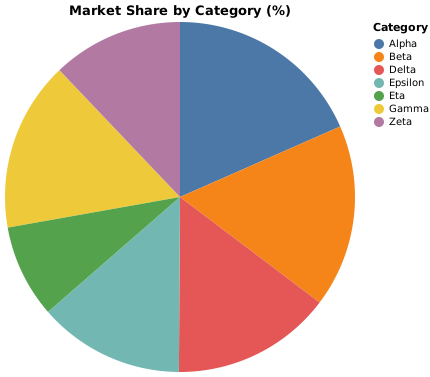
Without reading the exact percentages, rank the seven categories from largest to smallest share. How confident are you in your ranking? Which pairs of adjacent categories are hardest to distinguish?
Show explanation
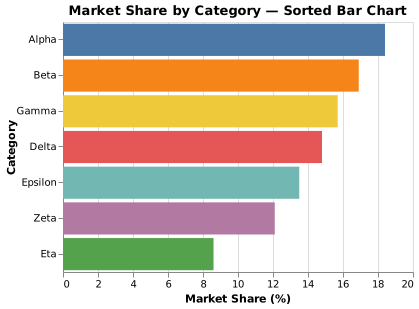
Human perception of angles and arc lengths is unreliable, especially when slices are similar in size. The shares range from 18.4% down to 8.6% — a meaningful spread — but most readers cannot reliably rank the middle five categories without reading the labels. A horizontal bar chart sorted by value requires only length perception, which humans perform much more accurately. Pie charts are defensible only when there are two or three slices with clearly different sizes.
Shows: how pie charts make ranking difficult when slices are similar in size, because angle and arc perception is far less accurate than length perception.
To find it: try to rank all slices from memory without reading the labels. If you cannot confidently order the middle categories, replace the pie with a bar chart sorted by value and compare how long the ranking takes. The bar chart should be almost instantaneous.
Predict individual student scores from district income data
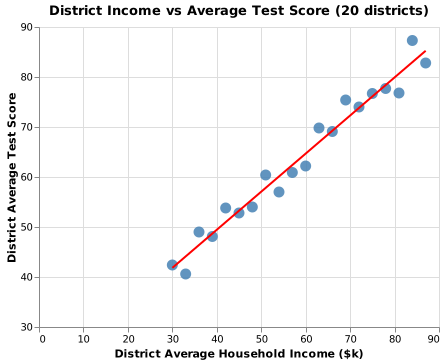
The chart shows that school districts with higher average household income have higher average test scores, with a tight regression line. Would you expect to be able to predict an individual student's score from knowing their district's average income? How accurate do you think that prediction would be?
Show explanation
The district-level chart uses 20 aggregate points, so noise is suppressed and the trend looks precise. But the district average income is a property of the district, not the student. Within any district, students from families with very different incomes sit in the same classrooms and take the same tests, and individual scores scatter widely around the district mean. A statistic that explains 95% of the variance across group averages may explain only 25-30% of the variance across individuals, because most of the individual variance is within-group and invisible in the aggregate chart. Drawing conclusions about individuals from group-level correlations is the ecological fallacy.
Shows: how group-level correlations can look much tighter than individual-level correlations, because averaging within groups suppresses within-group variance and makes the aggregate trend appear more predictive than it is.
To find it: if individual-level data is available, plot individual points instead of group averages. Compare the R² values for the two charts. If the individual-level R² is substantially lower than the group-level R², the group correlation was overstating predictive power for individuals. The gap between the two values is the proportion of individual variance that lies within groups and is invisible in the aggregate chart.
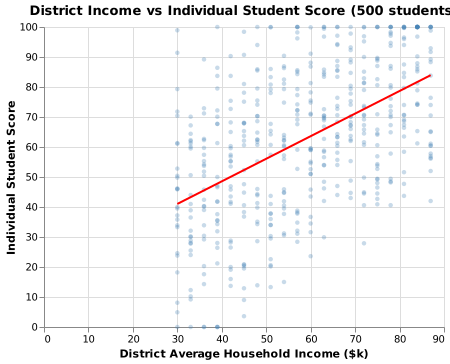
The upward trend is still present but the scatter is so wide that knowing a student's district tells you little about that student's score.