Observability
So far we’ve been collecting whatever data we want whenever something significant happens in the simulation, but we can’t do that in the real world. Since we need to tidy up the simulation a bit, let’s data collection a little more realistic as well.
The Overall Simulation
As before,
we’re going to store the major pieces of the simulation in a Simulation object
so that we don’t have to pass lots of bits and pieces to every function and method.
This class holds:
- the simulation parameters;
- the SimPy
Environment; - the developers (represented as
Developerobjects); - the queue of tasks waiting for a developer;
- the testers (represeented as
Testerobjects) and the queue of tasks waiting for them; and - an instance of a new
Logclass that will collect data about the state of the simulation.
class Simulation:
    """Overall simulation."""

    def __init__(self, params):
        """Construct."""

        self.params = params
        self.env = simpy.Environment()

        self.developers = [Developer(self) for _ in range(params["num_dev"])]
        self.dev_queue = simpy.PriorityStore(self.env)

        self.testers = [Tester(self) for _ in range(params["num_tester"])]
        self.test_queue = simpy.PriorityStore(self.env)

        self.logger = Log(self)
As before,
we provide some convenience methods to get at useful properties
of the underlying Environment:
class Simulation:
    …previous code…

    @property
    def now(self):
        """Shortcut for current time."""
        return self.env.now

    def process(self, proc):
        """Shortcut for running a process."""
        self.env.process(proc)

    def timeout(self, time):
        """Shortcut for delaying a fixed time."""
        return self.env.timeout(time)
and put all the randomization here as well:
class Simulation:
    …previous code…

    def rand_task_arrival(self):
        """Task arrival time."""
        return random.expovariate(1.0 / self.params["task_arrival"])

    def rand_test_time(self):
        """Testing time."""
        return random.lognormvariate(0, 1) * self.params["median_test_time"]

    def rand_rework(self):
        """Does this task need to be reworked?"""
        return random.uniform(0, 1) < self.params["prob_rework"]

    def rand_dev_time(self):
        """Development time."""
        return random.lognormvariate(0, 1) * self.params["median_dev_time"]
Finally, we provide one method to generate new tasks and one to launch all the active processes in the simulation:
class Simulation:
    …previous code…

    def generate(self):
        """Generate tasks at random intervals starting at t=0."""

        yield self.dev_queue.put(Task(self))
        while True:
            yield self.timeout(self.rand_task_arrival())
            yield self.dev_queue.put(Task(self))

    def run(self):
        """Run the whole simulation."""

        self.process(self.generate())
        self.process(self.logger.work())
        for workers in (self.developers, self.testers):
            for w in workers:
                self.process(w.work())
        self.env.run(until=self.params["sim_time"])
Two things to note in the code above:
-
We always generate the first task at time 0. We don’t have to do this, but it always felt weird looking at the statistics to have a small delay at the start before anything happened.
-
The logger is an active process, just like the developers, testers, and task generator. We’ll look at it in more detail in a bit.
Developers
Earlier posts in this series showed how we give each developer (and tester) a unique ID and how we automatically create lists of them. We won’t repeat that code here, since the most interesting thing about a developer is the work she does:
class Developer(Worker):

    def work(self):
        while True:
            task = yield self.sim.dev_queue.get()

            with WorkLog(
                self,
                (Worker.State.BUSY, Worker.State.IDLE),
                task,
                (Task.State.DEV, Task.State.WAIT_TEST),
                "n_dev",
                "t_dev",
            ):
                yield self.sim.timeout(task.required_dev)

            yield self.sim.test_queue.put(task)
If we ignore WorkLog for a moment,
we can see that Developer.work is:
    def work(self):
        while True:
            task = yield self.sim.dev_queue.get()
            yield self.sim.timeout(task.required_dev)
            yield self.sim.test_queue.put(task)
i.e., wait to a get a take from the development queue, pause for a while to do the work, and then put the task in the testing queue.
Recording Work
So what is WorkLog?
It’s a context manager,
i.e.,
a class that does something at the start of a block
and then automatically does some cleanup at the end of the block.
In our case,
what it does at the start is record the start time of the work
and change the state flags of the worker and task:
class WorkLog:
    """Context manager to keep track of elapsed time."""

    def __init__(self, worker, worker_states, task, task_states, key_num, key_time):
        """Construct."""

        self.worker = worker
        self.worker_states = worker_states
        self.task = task
        self.task_states = task_states
        self.key_num = key_num
        self.key_time = key_time
        self.start = None

    def __enter__(self):
        """Start the clock."""
        self.start = self.worker.sim.now
        self.worker.state = self.worker_states[0]
        self.task.state = self.task_states[0]
At the end of the block—i.e., after the simulated work is done—the context manager records how long the worker spent and how many tasks it has processed, then changes the states of the task and worker again:
class WorkLog:
    …previous code…

    def __exit__(self, exc_type, exc_value, traceback):
        """Stop the clock."""

        elapsed = self.worker.sim.now - self.start

        self.worker.state = self.worker_states[1]
        self.worker["busy"] += elapsed
        self.worker["n_task"] += 1

        if self.task_states[1] is not None:
            self.task.state = self.task_states[1]
        self.task[self.key_num] += 1
        self.task[self.key_time] += elapsed

        return False
Using WorkLog adds eight lines to what was a three-line simulation loop,
but we’ve learned the hard way as this code evolves
that keeping the record keeping for developers and testers in sync is error-prone.
Putting that code in a class,
and ensuring that the end-of-work record keeping is always done,
speeds up development.
Testers
The Tester class is similar to the Developer class:
class Tester(Worker):

    def work(self):
        while True:
            task = yield self.sim.test_queue.get()

            with WorkLog(
                self,
                (Worker.State.BUSY, Worker.State.IDLE),
                task,
                (Task.State.TEST, None),
                "n_test",
                "t_test",
            ):
                yield self.sim.timeout(task.required_test)

            if self.sim.rand_rework():
                task.priority = Task.PRI_HIGH
                task.state = Task.State.WAIT_DEV
                self.sim.dev_queue.put(task)
            else:
                task.state = Task.State.COMPLETE
This class gets work from the ready-to-test queue, and then decides once the work is done whether the task needs to be re-developed or not. If it does, it goes back into the ready-to-develop queue with high priority to ensure that tasks needing rework are done before tasks that haven’t been touched yet. Without this rule, far fewer tasks are completed, and far more tasks are half-done at the simulation’s end.
Logging
It’s finally time to look at the Log class that records data.
Its constructor makes space to record snapshots of
the states of all the tasks in the system,
the lengths of all the queues,
and what the developers and testers are doing:
class Log:
    """Keep a log of interesting things."""

    def __init__(self, sim):
        """Construct."""

        self.sim = sim
        self.snapshot = {
            "tasks": [],
            "queues": [],
            "workers": [],
        }
The generator that does the active work is simplicity itself: record the state of the simulation, then wait a fixed interval (which we will initially set to one clock tick):
    def work(self):
        while True:
            self._record()
            yield self.sim.timeout(self.sim.params["log_interval"])
The code to record the simulation state is a bit messy, because it depends on the implementations of various classes, but in brief it creates records for:
-
the state of every task in the system;
-
the lengths of the two queues; and
-
the state of each developer and tester.
    def _record(self):
        """Record a log entry at a particular moment."""

        now = self.sim.now
        for t in Labeled._all[Task]:
            self.snapshot["tasks"].append(
                {"time": now, "id": t.id, "state": str(t.state)}
            )
        for name, queue in (("dev", self.sim.dev_queue), ("test", self.sim.test_queue)):
            self.snapshot["queues"].append(
                {"time": now, "name": name, "length": len(queue.items)}
            )
        for kind, cls in (("dev", Developer), ("test", Tester)):
            for w in Labeled._all[cls]:
                self.snapshot["workers"].append(
                    {"time": now, "kind": kind, "id": w.id, "state": str(w.state)}
                )
What Have We Learned?
The first thing we learned from this refactoring is that roughly half the code is devoted to collecting data. This won’t come as a surprise to anyone who has ever built a monitoring tool: figuring out what’s going on is often as hard as making things happen, and sometimes harder.
The second thing we’ve learned is that our simulation can still surprise us. The graph on the left shows the lengths of the develpment and testing queues over time, while the one on the right shows how many tasks are in each of the possible states:
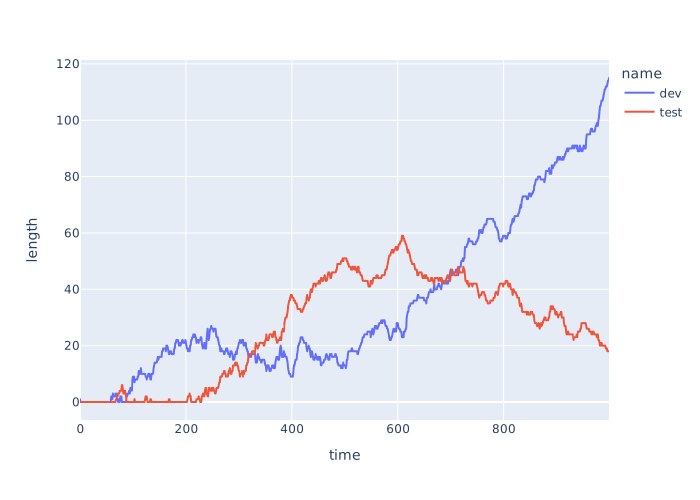
Queue Lengths
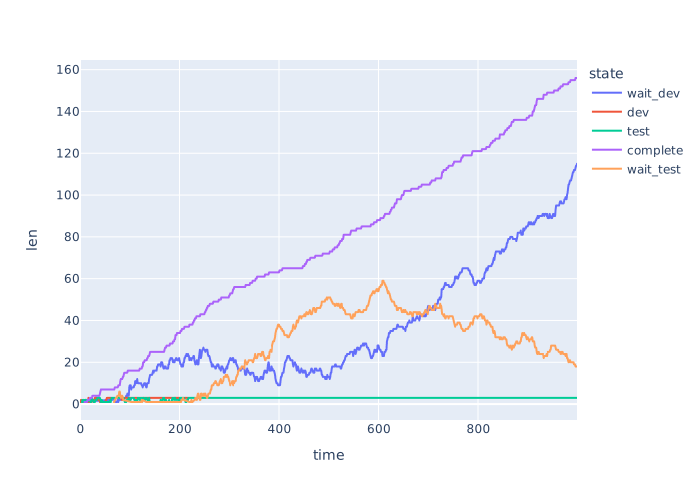
Task States
The steady growth in the number of tasks waiting for a developer makes sense: we’re generating new ones faster than they can be completed. But why does the length of the testing queue rise and then fall? Is it just random variation? Or is it revealing some unexpected property of our development process? That question will have to wait for tomorrow.